1 min read
7 Things Small Wineries Should Know About Winery Software
Running a small winery means wearing more hats than anyone ever prepared you for.
7 min read
Marketing : Updated on July 6, 2026
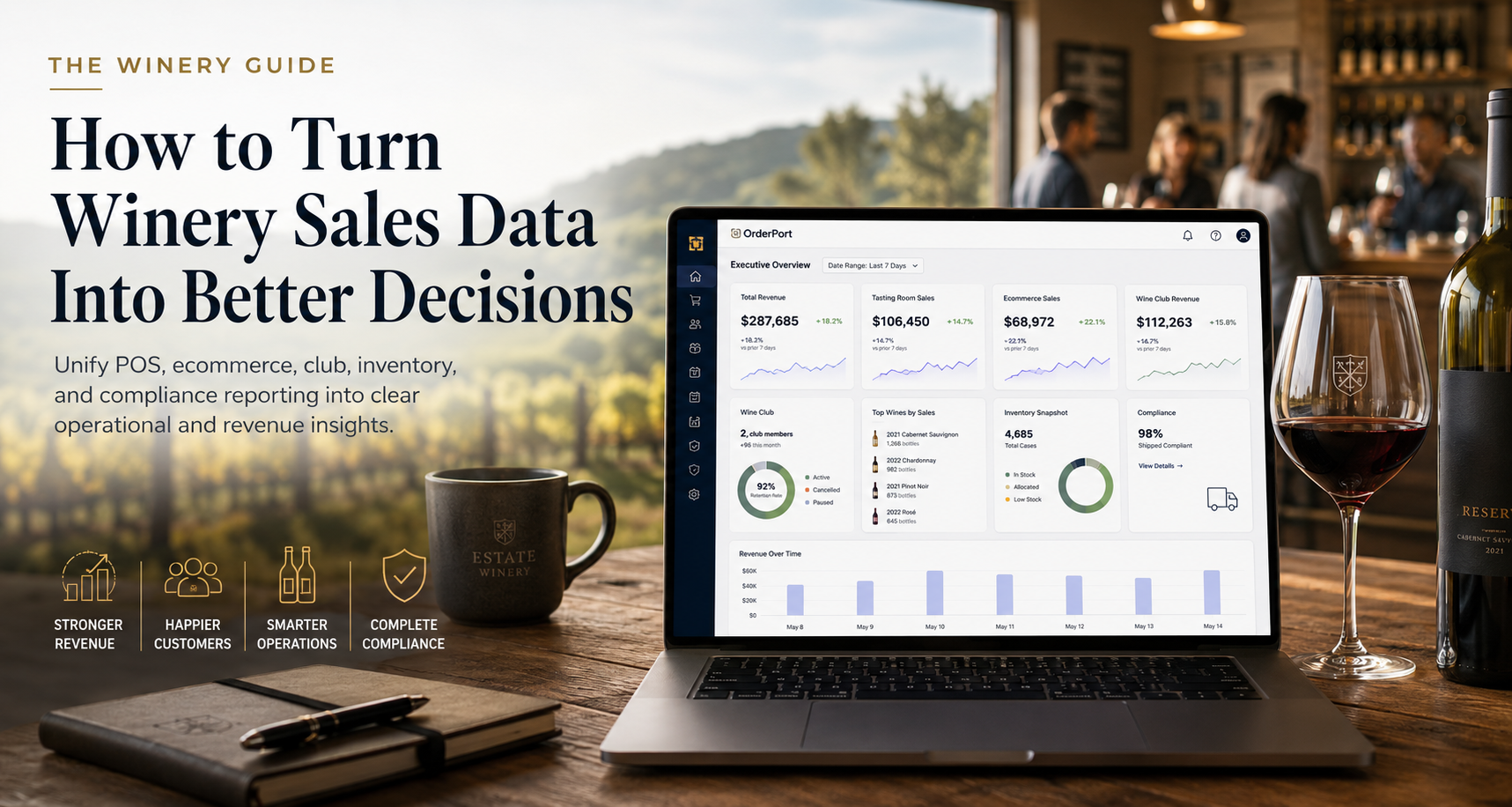
Every winery generates an incredible amount of data.
Your tasting room records every transaction. Your online store tracks customer purchases. Your wine club manages recurring shipments. Inventory moves with every bottle sold. Compliance software keeps shipping records up to date. Payments settle throughout the day. The information is all there, the challenge is that it's usually scattered across multiple systems, reports, and spreadsheets that rarely tell the same story.
By the time someone exports reports, combines spreadsheets, and reconciles numbers from different platforms, yesterday's performance has already become today's problem. The wineries making the best decisions in 2026 aren't collecting more data than everyone else. They're simply connecting the information they already have.
When every sale, customer interaction, inventory adjustment, club shipment, reservation, and online order lives in one connected platform, reporting stops being a monthly chore and starts becoming one of the most valuable tools your winery owns.
Many wineries assume they have a reporting problem when, in reality, they have a visibility problem.
Their tasting room sales are reported in one system, ecommerce performance in another, wine club billing in a third, and inventory and compliance each have their own separate dashboards. Every platform generates useful information, but none of them tells the complete story on its own.
Instead of seeing how every part of the business works together, winery teams are left piecing together disconnected reports, manually reconciling numbers, and hoping they're making decisions based on the full picture rather than a collection of isolated snapshots.
Each report answers one question reasonably well, but very few answer the questions that actually drive better business decisions.
How many guests who visited the tasting room joined the wine club?
Which wines are selling fastest across every sales channel?
Did last weekend's event increase online sales?
Which club shipments created repeat ecommerce purchases?
How much inventory should you allocate for the next release?
Answering questions like these shouldn't require downloading five CSV files and opening Excel. Unfortunately, for many wineries, that's exactly what happens.
Disconnected systems create far more than administrative headaches. They slow decision-making across every corner of the winery, forcing teams to spend valuable time searching for information instead of using it.
Marketing may launch a promotion without realizing inventory is running low. Tasting room associates might not see that a guest placed an online order just days before their visit. Wine club managers often find themselves manually verifying member information across multiple systems, while accounting spends hours reconciling deposits from different payment platforms. Even operations teams can lose valuable time comparing reports from separate applications before they feel confident enough to make a decision.
None of these tasks are particularly difficult on their own, but together they create friction that affects efficiency, customer service, and ultimately revenue. When every department works from a different set of data, even routine decisions become slower, more complicated, and more prone to costly mistakes.
Individually, these tasks may only take a few minutes. Collectively, they consume hours every week while increasing the likelihood of mistakes that affect inventory planning, customer service, forecasting, and profitability. Even worse, different departments often end up working from different versions of the same numbers.
When leadership can't confidently answer simple questions about sales, inventory, or customer activity, growth becomes reactive instead of intentional.
Your winery doesn't operate as separate businesses.
Guests don't think about whether they're buying through your tasting room, your website, or their wine club shipment.
To them, it's one winery.
Your technology should reflect that same experience.
Modern reporting starts by connecting five critical areas of the business.
Your tasting room is often the heartbeat of your direct-to-consumer business.
Every transaction tells a story about guest preferences, staff performance, average purchase value, and conversion opportunities.
When POS reporting connects with the rest of your winery, those sales become much more meaningful because they're tied directly to customer history instead of existing in isolation.
Instead of simply knowing what sold today, you begin understanding who purchased it, whether they're club members, how often they visit, and what they might purchase next.
Your online store continues selling long after the tasting room closes.
Ecommerce reporting should do far more than track website revenue.
It should reveal which wines perform best online, where customers come from, how promotions influence purchasing behavior, and how digital sales complement in-person experiences.
When online and in-person sales share the same customer record, you gain a complete view of buying habits that helps shape future marketing, inventory planning, and club growth.
Wine clubs represent recurring revenue, but they're also one of the richest sources of customer insight.
Membership growth, retention, shipment success, skipped releases, failed payments, and purchasing behavior all provide valuable indicators of long-term business health.
Rather than reviewing club performance independently, connected reporting allows wineries to understand how tasting room visits, ecommerce purchases, reservations, and member engagement influence retention over time.
Inventory shouldn't simply tell you how many bottles remain.
It should help you understand how inventory moves throughout your winery.
Which channels sell specific wines fastest?
Which club shipments will impact future availability?
Which wines are nearing allocation limits?
How much inventory should remain available online after this weekend's tasting room traffic?
These questions become much easier to answer when every sale updates inventory in real time across every channel.
Direct-to-consumer wineries operate within a highly regulated environment.
Shipping compliance, tax reporting, payment processing, and financial reconciliation all influence operational efficiency.
When compliance and payments integrate directly into your reporting, leadership gains confidence that revenue, shipments, and financial reporting accurately reflect what's happening across the business.
Every software platform can generate reports, but reports alone don't create better wineries. The real value comes from knowing which numbers deserve your attention and understanding how they connect to one another.
Instead of trying to monitor hundreds of data points, successful wineries focus on a core group of metrics that provide a clear picture of operational performance, customer behavior, and long-term growth. When viewed together, these insights make it much easier to identify trends, spot opportunities, and respond before small issues become larger problems.
Some of the most valuable metrics include:
Individually, each metric offers useful information. Together, they tell a much richer story about how your winery is performing. Rather than reacting to isolated reports from different departments, leadership gains a connected view of the business, making it easier to prioritize investments, improve guest experiences, and make confident decisions that support sustainable growth.
The best reports don't just tell you what happened yesterday. They help you decide what to do tomorrow.
It's easy to celebrate a record sales weekend in the tasting room, but the real value comes from understanding what drove those results and how to build on them. Did more guests join the wine club? Which wines generated the highest average purchase value? Did the event lead to an increase in online orders over the following week? Should inventory be reallocated before the next busy weekend, or is it time to reorder packaging supplies ahead of an upcoming club shipment?
The same kind of thinking applies across every area of the winery. If wine club retention begins to slip, connected reporting should help uncover the underlying cause. Perhaps failed payment attempts have increased, shipment timing no longer aligns with member expectations, tasting room visits from members have declined, or purchasing patterns have shifted toward fewer discretionary purchases. Understanding why something changed is far more valuable than simply knowing that it did.
This is where connected data becomes a strategic advantage. Instead of reacting to isolated numbers, winery leaders can identify relationships between sales channels, customer behavior, inventory movement, and club performance. Reporting evolves from a historical record into a decision-making tool that helps you recognize trends sooner, respond with confidence, and make proactive choices that strengthen both operations and long-term revenue.
Spreadsheets have their place, and nearly every winery relies on them for one task or another. The problem isn't using spreadsheets, it's depending on them to connect information that should already be connected.
When reports have to be exported from your POS, ecommerce platform, wine club software, inventory system, and payment processor before anyone can understand how the business is performing, reporting becomes a manual process rather than an operational advantage. Teams spend hours copying data, updating formulas, reconciling discrepancies, and double-checking numbers instead of analyzing trends and making informed decisions.
As wineries grow, those challenges only become more pronounced. Multiple departments begin maintaining their own spreadsheets, historical comparisons become harder to manage, and it's not uncommon for two people to present different versions of the same report. Even small formula errors or outdated files can lead to inaccurate forecasts, poor inventory decisions, or missed opportunities.
Eventually, leadership reaches a tipping point where more time is spent preparing reports than acting on what the reports reveal. That's often the clearest sign that disconnected systems are no longer just creating extra work—they're holding the winery back from making faster, more confident decisions.
Imagine starting each morning with a complete view of your winery already waiting for you.
Yesterday's tasting room sales have been recorded alongside overnight ecommerce orders. Wine club shipments are reflected automatically, inventory has updated across every sales channel, payment deposits have been reconciled, and upcoming reservations provide a clear picture of what's ahead. Every customer profile tells the full story of their relationship with your winery, combining tasting room visits, online purchases, club memberships, reservations, and past interactions into a single record.
Instead of gathering reports from different departments or exporting data from multiple systems, your team begins the day with shared visibility into the business. Sales, hospitality, marketing, operations, and leadership are all working from the same information, making it easier to identify trends, answer questions, and respond quickly to new opportunities.
That kind of visibility changes more than reporting. It changes how a winery operates. Decisions happen faster because they're based on complete, connected information rather than fragmented data, allowing every department to work together with greater confidence, efficiency, and focus on delivering exceptional guest experiences.
This connected view is exactly what OrderPort was built to deliver.
Rather than asking wineries to manage separate platforms for point of sale, ecommerce, wine clubs, reservations, payments, inventory, customer management, and reporting, OrderPort brings those functions together within a single, winery-specific platform.
Every transaction updates the same customer record.
Inventory adjusts automatically across every sales channel.
Wine club activity appears alongside tasting room visits and online purchases.
Reservations, payments, and guest history all contribute to a complete picture of each customer relationship.
Because every part of the business shares the same data, reporting becomes significantly more accurate while dramatically reducing manual work.
Instead of exporting spreadsheets and reconciling numbers, winery teams spend more time understanding their business and less time searching for answers.
Whether you're reviewing daily tasting room performance, evaluating club retention, planning future inventory, or measuring marketing campaigns, you're working from one trusted source of information rather than several disconnected systems.
Successful wineries don't grow because they have access to more reports.
They grow because they have confidence in the reports they're using.
When your POS, ecommerce store, wine club, reservations, inventory, payments, and compliance all work together, reporting becomes far more than a record of yesterday's activity. It becomes a strategic advantage that helps you forecast demand more accurately, strengthen customer relationships, optimize staffing, improve inventory planning, and uncover new opportunities for growth.
The data already exists within your winery.
The opportunity is bringing it together.
With OrderPort, every transaction, every guest interaction, every shipment, and every bottle sold contributes to one connected view of your business, giving you the clarity to make faster decisions, operate more efficiently, and build a stronger direct-to-consumer winery for years to come.

1 min read
Running a small winery means wearing more hats than anyone ever prepared you for.
1 min read
Introduction: The Power of Club Loyalty

1 min read
What Today’s Winery Guests Expect Online The expectations guests bring to your winery’s digital presence have fundamentally changed. What worked...