1 min read
What Is a Winery Technology Stack in 2026?
What Is a Winery Technology Stack in 2026? Walk into almost any winery and you'll find a collection of software quietly keeping the business moving....
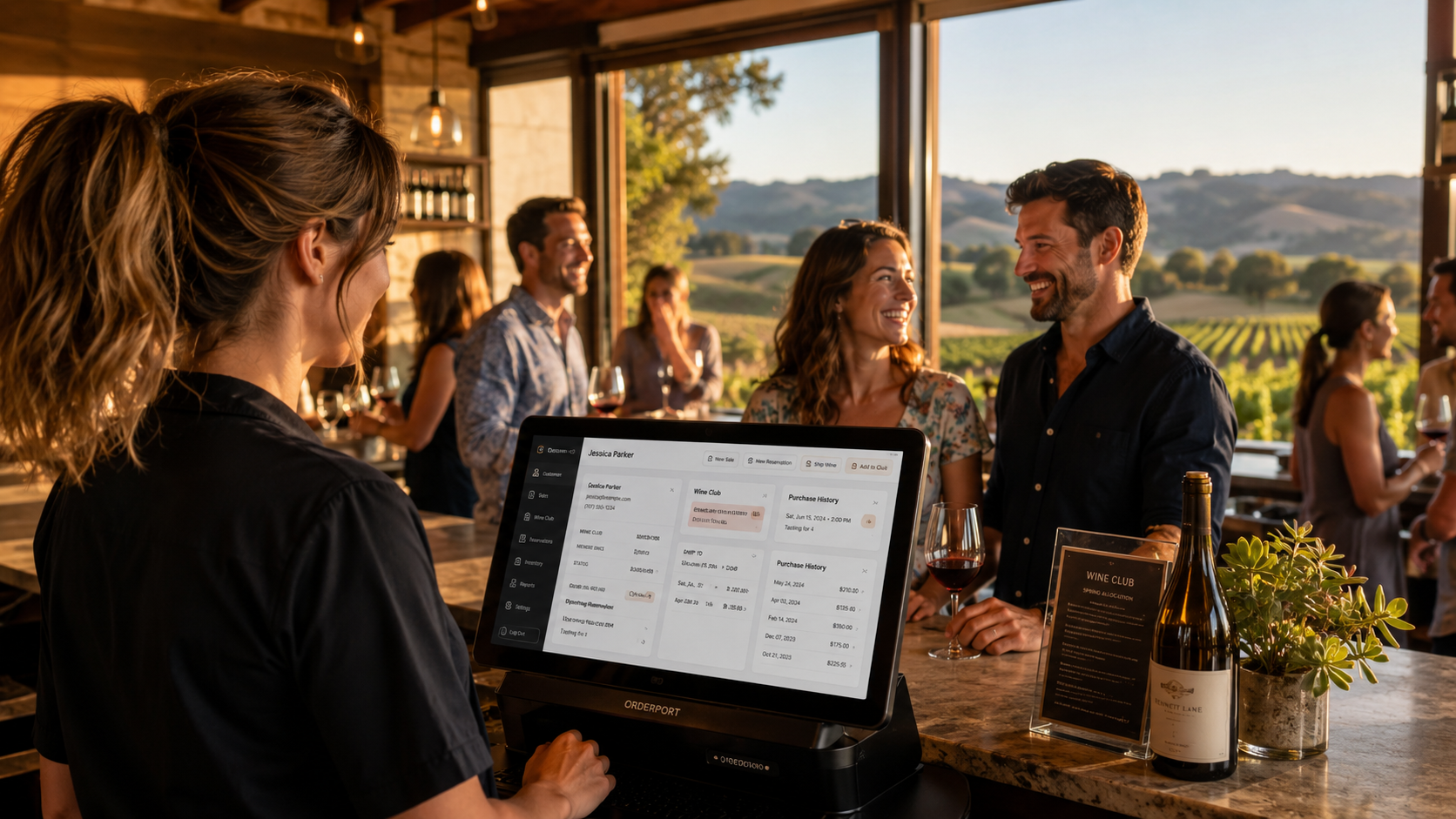
When wineries talk about labor challenges, the conversation almost always starts in the same place: finding good people, keeping good people, and managing the rising cost of labor in an increasingly competitive market. Those concerns are real, and nearly every winery is feeling the pressure in one way or another.
What often gets overlooked, however, is another issue quietly affecting productivity, employee satisfaction, and profitability every single day. It's not a staffing problem at all. It's operational friction.
Operational friction is the accumulation of all the small inefficiencies that creep into daily work when systems, processes, and information aren't working together the way they should. It's the employee who has to enter the same customer information twice because two systems don't communicate. It's the spreadsheet someone updates manually every week because there isn't an easier way to pull the data. It's the customer record that lives in multiple places, each containing slightly different information. It's the report that requires two hours of exporting, sorting, and formatting when the information should be available with a few clicks.
None of these tasks seem particularly significant on their own. In fact, most wineries have become so accustomed to them that they barely notice them anymore. Yet when those extra minutes are repeated dozens of times each day, across multiple employees and departments, they quickly add up to hundreds of lost hours over the course of a year.
The result is a team that constantly feels busy but rarely feels caught up, where employees spend more time navigating processes than serving guests, and where managers often conclude they need more staff when the real issue may be that too much of their team's time is being consumed by work that shouldn't exist in the first place.
Why Wineries Feel Understaffed
Ask most winery managers whether they need more staff and many will immediately say yes. After all, the demands placed on today's winery teams seem to grow every year. Guests expect more personalized experiences, wine club members expect timely communication and seamless service, and internal teams are being asked to accomplish more with the same resources.
Yet when you take a closer look at what employees are actually doing throughout the day, the problem is often not a shortage of people. More often, it's a shortage of efficiency.
Consider a typical tasting room associate. Over the course of a single shift, they may welcome guests, process purchases, answer questions about wine club memberships, enroll new members, update customer notes, check reservation details, look up shipment information, and follow up on guest inquiries. None of those responsibilities are unusual, and all of them contribute to the guest experience.
The challenge begins when the information needed to perform those tasks is scattered across four or five different systems. Instead of focusing on the guest standing in front of them, employees find themselves jumping between screens, searching for customer records, verifying information that should already be available, and manually entering data that exists somewhere else in the organization.
While those tasks may feel like part of the normal routine, they create very little value for either the winery or the guest. They don't generate additional revenue. They don't strengthen relationships. They don't create memorable experiences that encourage guests to return. What they do consume is time, often far more time than most wineries realize.
Over the course of a day, those extra minutes accumulate. Over the course of a month, they become dozens of hours. Over the course of a year, they can represent the equivalent of weeks of productive labor that never actually reaches the guest.
This is why so many wineries feel understaffed despite having capable teams in place. Employees aren't spending all of their time serving guests, building relationships, and driving sales. Too much of their day is spent managing systems, chasing information, and working around operational inefficiencies that have quietly become accepted as normal.
One of the biggest sources of operational friction is duplicate work.
Many wineries operate with separate systems for:
When systems don't communicate effectively, employees inevitably become the bridge connecting them, filling gaps that technology should be handling automatically.
A guest updates their email address through your website, but because that information doesn't flow everywhere it needs to go, someone on your team eventually has to update it somewhere else. A new wine club member signs up during a tasting, yet their information still needs to be manually entered into another platform before the record is complete. A reservation guest purchases several bottles during their visit, but that purchase history doesn't automatically appear where staff members expect to find it the next time the guest returns.
None of these situations feel particularly dramatic in the moment. In fact, they happen so frequently at many wineries that they've become part of the normal routine. The problem is that every manual update creates additional work, every extra step consumes valuable time, and every handoff between systems introduces another opportunity for mistakes, inconsistencies, or missing information.
Over time, these seemingly minor tasks begin to compound. Employees spend more of their day maintaining records, reconciling information, and correcting errors, while spending less of it doing the work that actually drives winery success: welcoming guests, building relationships, creating memorable experiences, and generating revenue. The hidden cost isn't simply the time spent updating data. It's the opportunity cost of everything your team could have been doing instead.
Many winery owners view inefficiency as a productivity problem.
In reality, it affects nearly every aspect of the business.
Nobody enjoys repetitive administrative work.
Employees generally join the wine industry because they enjoy hospitality, wine, and connecting with people.
They do not get excited about manually reconciling reports or entering the same information multiple times.
Over time, constant operational frustration contributes to burnout.
Employees become less engaged.
Training takes longer.
Turnover increases.
Guests don't see the disconnected systems behind the scenes.
They only experience the symptoms.
Longer wait times.
Repeated questions.
Missing information.
Inconsistent service.
Delayed follow-up communications.
The guest may never know why the experience felt frustrating, they simply remember that it did.
Managers are often affected as well.
When information lives in multiple places, reporting becomes difficult.
Questions that should be easy to answer become time-consuming projects.
Examples include:
When data is fragmented, decision-making slows down.
Many wineries are surprised when they identify where employees actually spend their time.
Common operational bottlenecks include:
Many managers spend hours compiling reports from multiple systems. This time adds up quickly throughout the month.
Updating customer records in multiple locations creates unnecessary administrative work.
Processing shipments, handling exceptions, updating payment information, and managing communications can consume significant staff resources.
Departments often operate independently. The tasting room, ecommerce team, wine club manager, and fulfillment staff may all work from different information sources. This creates delays, confusion, and duplicate effort.
Complex systems require longer onboarding periods and the more tools employees must learn, the longer it takes them to become productive.
The encouraging news is that solving these challenges does not always require expanding your payroll. In many cases, meaningful improvements can be achieved simply by reducing friction and making everyday work easier for the team you already have.
One of the simplest exercises a winery can conduct is asking employees a straightforward question:
"What tasks do you perform every day that feel repetitive, unnecessary, or more difficult than they should be?"
The answers are often revealing. Employees usually know exactly where inefficiencies exist because they encounter them every day. They know which reports take too long, which processes require duplicate work, and which systems create frustration. In many cases, identifying the problem is the easiest part of the solution.
Every time information is entered twice, reviewed twice, or managed in multiple locations, productivity suffers.
While a duplicate step may only take a few minutes, those minutes compound rapidly when repeated across dozens of employees and hundreds of transactions. Eliminating duplicate processes is often one of the fastest ways to improve efficiency because it immediately removes work that never needed to exist in the first place.
Not every task requires human involvement.
Examples include:
Automation allows employees to focus on guest-facing activities.
The fewer places employees need to look for information, the more efficient they become. Connected systems help create a single view of the customer and reduce administrative workload.
One of the most important lessons modern wineries can embrace is that efficiency is not about asking employees to work harder. It is about identifying work that should not exist and finding ways to eliminate it.
Every hour recovered through streamlined operations creates capacity somewhere else within the organization. Employees spend more time engaging with guests. Managers gain greater visibility into business performance. Customer experiences become more consistent. Growth becomes easier to manage.
The goal is not simply to do more work. The goal is to create space for more meaningful work.
Labor challenges are unlikely to disappear anytime soon. Finding, developing, and retaining talented employees will remain one of the most important priorities facing wineries for years to come.
Yet many wineries have a significant opportunity sitting directly in front of them.
Before hiring additional staff, it may be worth examining how much time is currently being lost to operational friction, disconnected systems, and unnecessary administrative work. Often, the greatest opportunity for improvement is not adding more people, but making it easier for
Want to identify hidden operational bottlenecks in your winery?
Download our Winery Operational Efficiency Assessment and discover where your team may be losing time, creating duplicate work, and experiencing unnecessary friction.
A few simple changes could free up hours every week while improving both employee satisfaction and guest experience.
1 min read
What Is a Winery Technology Stack in 2026? Walk into almost any winery and you'll find a collection of software quietly keeping the business moving....
1 min read
Employee retention isn't just about hiring the right people. It's about giving them the tools, support, and confidence to succeed from day one.
1 min read
Walk into almost any winery on a busy Saturday afternoon and you'll see the same scene unfolding. Guests are laughing over a tasting flight, someone...