1 min read
How Do Wineries Simplify Launching Flexible Wine Club Subscription Programs?
For years, wine clubs have been one of the most reliable drivers of direct-to-consumer revenue. They create predictable income, strengthen customer...
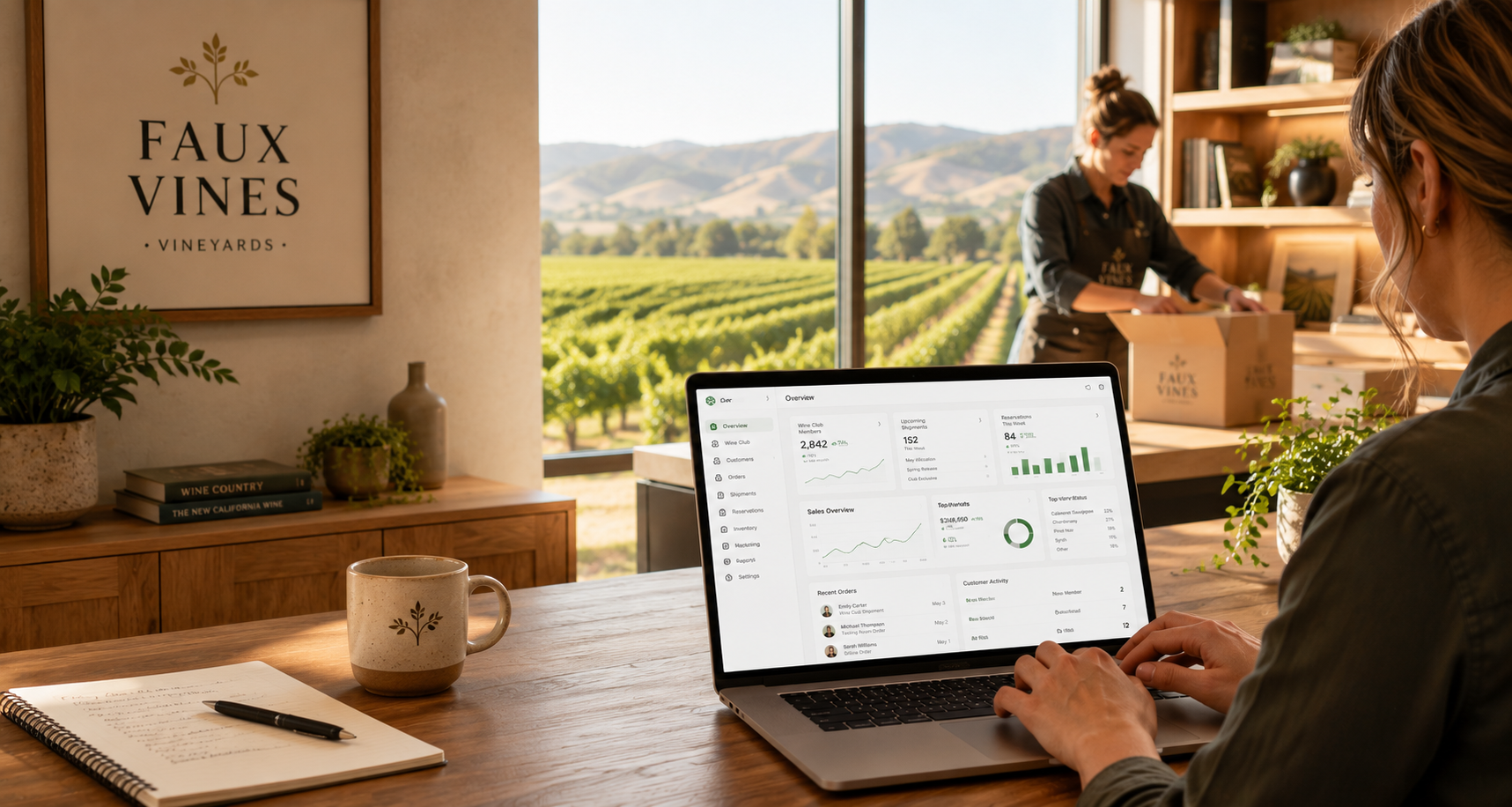
Every winery reaches a point where the systems that helped launch a successful wine club begin showing their age.
At first, it isn't obvious.
A spreadsheet gets a little larger. Staff start keeping handwritten notes. Someone builds a workaround for shipment processing. Marketing exports become part of the monthly routine. Reservations live in one platform, ecommerce in another, and inventory somewhere else entirely.
None of these changes seem like a major problem on their own.
But over time, they begin stacking on top of one another until what should be a straightforward shipment becomes an all-hands effort involving multiple people, countless spreadsheets, and a healthy amount of crossed fingers.
The irony is that many wineries assume they've outgrown their wine club.
More often than not, they've simply outgrown the way they're managing it.
As wineries continue to navigate tighter margins, evolving customer expectations, and increased competition in 2026, the ability to eliminate operational bottlenecks has become just as important as attracting new members. The smoother your internal processes become, the more consistent and personal every member interaction feels.
When wineries think about wine club retention, they often focus on the visible parts of the member experience: the wines, the benefits, the pickup parties, and the tasting room experience.
Those things matter, but members often decide whether to stay based on the smaller interactions that happen throughout the year.
Was their shipment accurate? Did their card process without an issue? Were they recognized when they arrived for a tasting? Did they receive relevant communications? Could they easily update their preferences?
Behind each of those moments is an operational workflow. When those workflows rely on spreadsheets, disconnected software, or manual processes, small mistakes become inevitable. A missed preference, an incorrect shipment, or a duplicate email may seem minor on its own, but over time they chip away at the seamless experience members expect.
The wineries with the strongest retention don't necessarily have bigger teams. They've simply removed much of the manual work that creates those mistakes in the first place.
Growth is exciting, but it also has a way of exposing weaknesses that weren't obvious when your club was smaller.
If any of these situations sound familiar, there's a good chance your workflow—not your wine club—is creating unnecessary friction.
Everyone drops what they're doing. Marketing pauses. Hospitality jumps in. Operations stays late.
Wine club shipment processing shouldn't require the entire winery to shift into emergency mode every quarter. If shipment week always feels stressful, your process is likely relying on far more manual work than it should.
One spreadsheet for billing. Another for inventory. Another for marketing. Another for customer notes.
Eventually, spreadsheets stop organizing information and start bridging systems that don't communicate. Every export creates another opportunity for outdated data, duplicate records, or simple human error.
A member updates their shipping address online, but the tasting room doesn't see it. Their favorite wine is noted after a visit, but marketing never uses it. They book a reservation, yet the system doesn't recognize they're a club member.
From the member's perspective, it feels like they're starting from scratch every time they interact with your winery. That's not a hospitality problem, it's a disconnected data problem.
Few things create more frustration than discovering a club wine sold online that had already been promised to members.
Disconnected inventory systems often require manual reconciliation, especially during busy seasons when every bottle matters.
The more places inventory exists, the harder it becomes to trust any one number.
"What shipment am I receiving?"
"When will my card be charged?"
"Can I skip this shipment?"
"Can I customize my order?"
Many of these questions can be answered proactively through automated communications, giving your team more time to focus on creating memorable guest experiences instead of responding to repetitive administrative requests.
Every winery has that one employee who knows exactly which spreadsheet to open, which report to export, and which buttons need to be clicked in exactly the right order.
They're incredibly valuable.
They're also carrying an enormous amount of institutional knowledge that shouldn't be required just to run a wine club.
Healthy systems create consistency regardless of who's working that day.
Most wine club bottlenecks aren't caused by one major issue. They're the result of dozens of small tasks that add up over time.
Customer information gets updated in multiple places. Inventory is adjusted manually after shipments. Marketing exports lists before every campaign. Reservations don't recognize club members automatically. Reports from different systems have to be pieced together before anyone has a clear picture of performance.
Each task only takes a few minutes. Together, they consume hours that could be spent serving guests and growing your wine club.
Multiply that across hundreds of members, several employees, and multiple club shipments every year, and suddenly dozens—or even hundreds—of staff hours disappear into administrative work.
This is where connected systems begin making a noticeable difference. Instead of moving information between platforms, information simply follows the customer.
A reservation updates the customer profile, a purchase updates inventory, a shipment updates reporting and an email reflects current membership status automatically. The technology fades into the background, allowing your team to spend less time maintaining systems and more time building relationships.
One of the biggest misconceptions in the wine industry is that automation somehow removes the personal touch.
In reality, the opposite is usually true.
No guest has ever left a tasting thinking,
"I wish they had spent less time talking with us and more time updating spreadsheets."
Automation isn't about replacing conversations.
It's about removing repetitive administrative work that prevents those conversations from happening.
When payment reminders are scheduled automatically, staff spend less time making phone calls.
When member communications send at the right time, guests stay informed without anyone manually building mailing lists.
When customer preferences follow them from ecommerce to reservations to the tasting room, every interaction feels more personal because your team already has the information they need.
The goal isn't to automate relationships.
It's to automate everything surrounding them.
Imagine a member booking a tasting for the weekend.
Before they arrive, your reservation system recognizes their club membership, purchase history, and preferences. Your tasting room team is ready with the context they need to create a personalized visit.
During the tasting, purchases update inventory automatically, event reservations are captured instantly, and a follow-up email reflects the wines they actually enjoyed.
When their next club shipment is processed, everything is already in sync. Preferences are current, inventory is accurate, payment runs smoothly, and every interaction is reflected in a single customer profile.
No duplicate records, manual imports or disconnected systems.
Just one seamless experience for your members and a much simpler workflow for your team.
Many wineries don't actually have a technology problem. They have a disconnected technology problem.
Over the years, it's easy to add software for every part of the business—a reservation platform, ecommerce site, POS, CRM, email marketing tool, shipping software, and reporting solution. Individually, each may do its job well. The challenge is getting them to work together.
When systems don't share information, your team becomes the integration. They're exporting reports, reconciling inventory, updating customer records, and making sure every platform reflects the same information.
Instead of adding more software, many wineries see the biggest gains by simplifying their technology stack. When your wine club, tasting room, ecommerce, reservations, payments, marketing, and reporting all work from the same customer and inventory data, information flows naturally across the business.
The result is less manual work, fewer opportunities for mistakes, and more time spent creating the kind of experiences that keep members coming back.
Before your next club release, take a step back and look beyond the shipment itself.
Ask yourself:
If several of those questions gave you pause, the issue probably isn't your wine club, it's the workflow supporting it.
The strongest wine clubs aren't simply the ones with the largest membership numbers.
They're the ones supported by systems that make every interaction feel effortless—for both members and staff.
As your winery grows, manual processes that once seemed manageable eventually become barriers to providing the kind of hospitality your guests remember. Removing those barriers doesn't require sacrificing the personal experience that defines great wineries. If anything, it gives your team more time to focus on exactly what they do best: welcoming guests, sharing your story, and building lasting relationships.
That's the advantage of operating from one connected platform.
When your wine club, tasting room, reservations, ecommerce, payments, marketing, and reporting all work together, every department has access to the same customer information, every interaction becomes more consistent, and every decision is backed by accurate data instead of disconnected spreadsheets.
At OrderPort, that's exactly what we've built. Our unified platform brings every part of the direct-to-consumer business together so wineries can spend less time managing technology and more time creating experiences that keep members coming back year after year.
Because the best wine clubs aren't powered by more software.
They're powered by software that works together.
1 min read
For years, wine clubs have been one of the most reliable drivers of direct-to-consumer revenue. They create predictable income, strengthen customer...
1 min read
For small wineries, recurring revenue is one of the most valuable assets a business can build.
1 min read
For years, winery wine clubs followed the same formula.