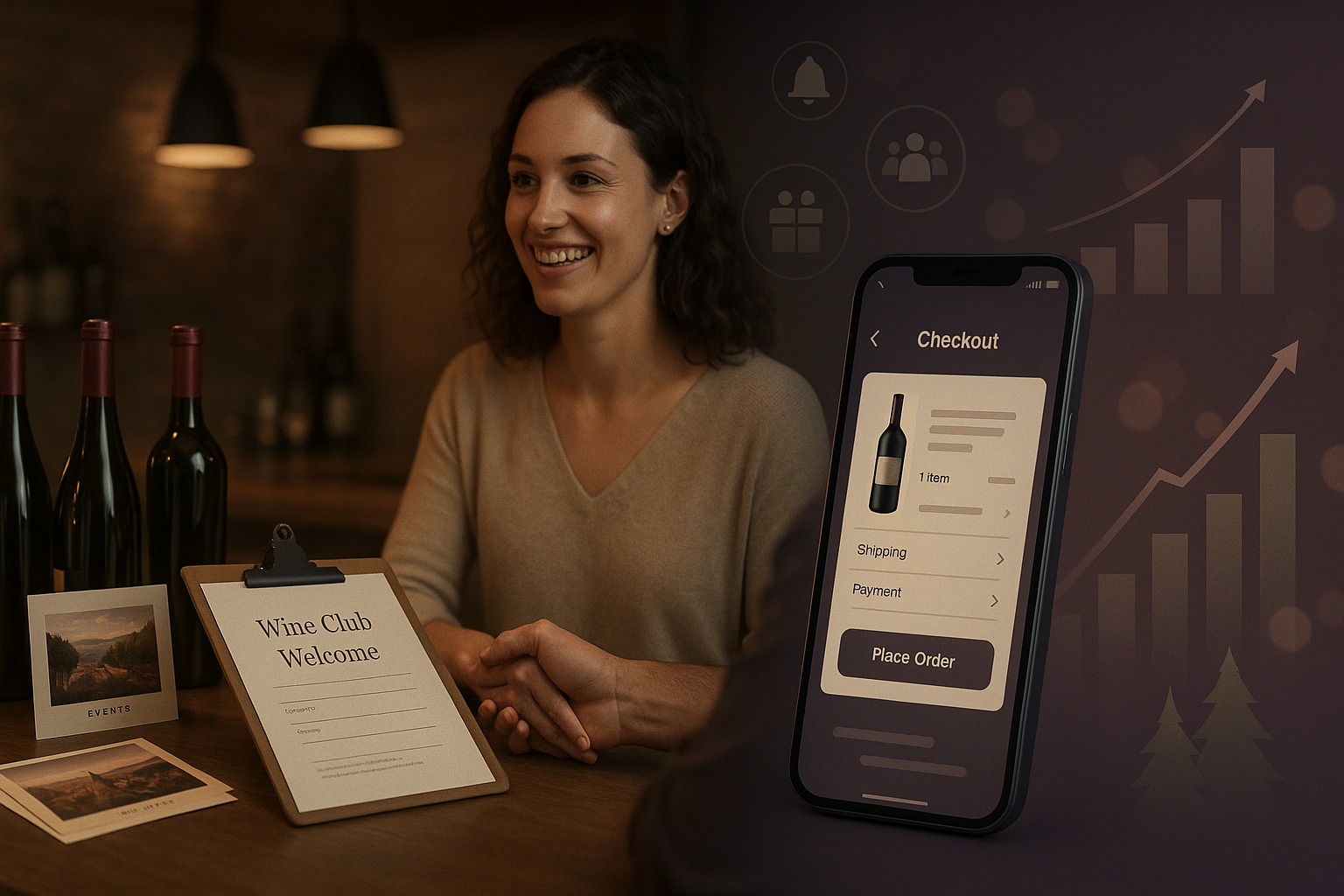
DTC wine sales entered 2025 with equal parts optimism and uncertainty. After two years of...
DTC Wine Sales: 2025 Highlights and Lessons Learned
The direct-to-consumer channel has always been a resilient engine for wineries. But in 2025, something subtle — and important — changed.
DTC sales became smarter: more predictable, more operationally mature, and more deeply tied to the guest experience.
Growth this year wasn’t driven by splashy campaigns or deeper discounts. It came from systems, workflows, and membership experiences that made revenue steadier all year long.
This was a year of clarity revealing:
-
how customer behavior is shifting,
-
what drives wine club stability,
-
why data now guides every operational decision, and
-
how the holiday season influences performance across the entire calendar.
Industry data confirms it: year-over-year growth returned to the DTC channel after two years of volatility, powered by ecommerce strength, event-driven acquisition, and better club retention. (Silicon Valley Bank State of the Wine Industry, 2024)
See the full 2025 Highlights + 2026 Vision Infographic.
2025: A Year of Stabilization and Smarter Growth
Three major forces defined the year:
1. Wine Clubs Regained Their Position
After two years of churn pressure, clubs stabilized, especially for wineries with:
-
clear tiers
-
simplified benefits
-
intentional onboarding
Growth leaned toward quality over quantity. Wineries prioritized segmentation to increase AOV, avoiding blanket discount tactics.
(Sovos DTC Shipping Report, 2025)
2. Ecommerce Conversion Became an Operational Metric
Mobile performance and checkout speed became revenue-critical. During peak gifting windows, 56% of purchases occurred on a mobile device. (NielsenIQ, 2025)
The most successful operators applied retail-style tactics:
-
tighter windows
-
timed promos
-
clear gift bundles
-
urgency without fatigue
Higher conversion, lower discounting.
3. Events → Club Pipeline Became Proven
Guests who engaged in tasting rooms or events were in a buying mindset and wineries that followed up within 48 hours converted best into membership.
(Wine Business Monthly, 2024)
The industry learned: the event isn’t the moment. The relationship begins when guests go home.
4. Automation Became Time Savings
Small but consistent automations delivered outsized operational relief:
-
pickup reminders
-
reorder nudges
-
thank-you sequences
-
pre-shipment alerts
-
club welcome flows
For 2–4 person DTC teams, these added back hours each week.
What Wineries Learned About Consumer Behavior
Three behavioral shifts defined the year:
Experience > Transaction
Members want connection: craft, story, terroir, and real people behind the wine.
Discount-led clubs experienced churn.
Value-led clubs grew.
Gifting Is Rising as Loyalty Softens
Holiday gifting volume increased and purchasing began earlier, shifting from last-minute buying to intentional, planned gifting.
Long-term memberships still grow, but only when the value is unmistakably clear.
Mobile-First Is the Default
Consumers expect:
-
discovery
-
checkout
-
gift notes
-
shipping options
…all in a single, frictionless mobile flow.
Mobile is no longer a secondary experience, it is the primary one.
Holiday Sales Now Predict 2026
Holiday performance now signals:
-
Q1 reorder behavior
-
membership retention through spring
-
club acquisition potential
-
lifetime value from gift buyers
Seasonal volume has become a leading indicator, not a year-end spike.
Read the Holiday Campaign Recap.
How 2025 Is Shaping 2026
The core takeaway is simple:
In DTC wine sales, operational depth is the new competitive advantage.
Systems matter more than campaigns.
The winning operators are shifting toward:
-
unified commerce platforms
-
membership experience design
-
behavior-led segmentation
-
streamlined service workflows
-
data-informed decision making
These themes shape the 2026 predictions.
Lessons Wineries Can Apply Immediately
Five takeaways that drive results:
-
Club Architecture Is Strategic
Benefits should compound value, not dilute it through discounts. -
Segmentation Drives AOV
Treat locals, travelers, gift buyers, and members as distinct groups. -
Event Follow-Up Converts
Assign someone to own the 48-hour outreach window. -
Automation Saves Time
Simple sequences outperform complex funnels. -
Mobile Is the Primary Customer
Build backwards from the phone in a guest’s hand.
FAQ: 2025 DTC Insights
-
What drove DTC growth in 2025?
Stabilizing clubs, stronger holiday performance, and unified ecommerce workflows. -
Did discounts impact churn?
Yes — discount-heavy clubs saw higher churn. -
Why was mobile checkout so important?
Over half of holiday purchases were made on mobile. -
Are events still strong for club acquisition?
More than ever, especially with quick follow-up. -
Did gifting grow in 2025?
Yes — earlier and higher-volume purchasing. -
How does segmentation affect AOV?
Relevance increases spend more than generic offers. -
Did wineries automate more?
Most adopted simple automations with high ROI. -
Why unify commerce?
Real-time visibility across TR, club, ecommerce, and events boosts profitability. -
Does DTC depend on advertising?
Not primarily — workflow efficiency outperformed ad spend. -
What will drive 2026?
Membership design, unified systems, and data-driven optimization.
Conclusion
2025 proved that predictable DTC revenue comes from operational clarity.
The wineries that grew the most unified their systems, simplified club architecture, embraced mobile, leveraged events for acquisition, and used segmentation to increase AOV.
As 2026 planning begins, focus on:
-
unified commerce
-
intentional membership design
-
building data into your everyday decisions
Download the 2026 Roadmap for DTC Wineries to turn these insights into next year’s growth strategy.