1 min read
From Tasting Notes to Emotional Hooks: Writing Copy People Actually Buy From
Blackberry. Cedar. Vanilla. Great. But no one buys a case because of “hints of graphite.”
3 min read
Marketing : Updated on May 6, 2026
Most wineries already have strong stories, and the problem is not a lack of material; the problem is placement. Stories often live on the About page or get buried in long-form content that customers never see during the buying process.
If your best story is not showing up where decisions are made, it is not doing its job.
Customers move quickly through digital experiences. They scan, they compare, and they make decisions in seconds. If your story does not appear at the exact moment they are deciding whether to buy, join, or visit, it gets overlooked.
The goal is not to tell more story. The goal is to place the right story in the right moment so it supports a decision.
These are the touchpoints where your story directly influences conversion. If you focus here first, you will see the fastest impact.
This is your first impression and often your only chance to communicate what makes you different.
Most winery homepages lead with generic language or simple statements about quality. Instead, use this space to express a clear point of view and give the visitor a reason to keep exploring.
A strong homepage message should answer a simple question. Why should I care about this winery right now?
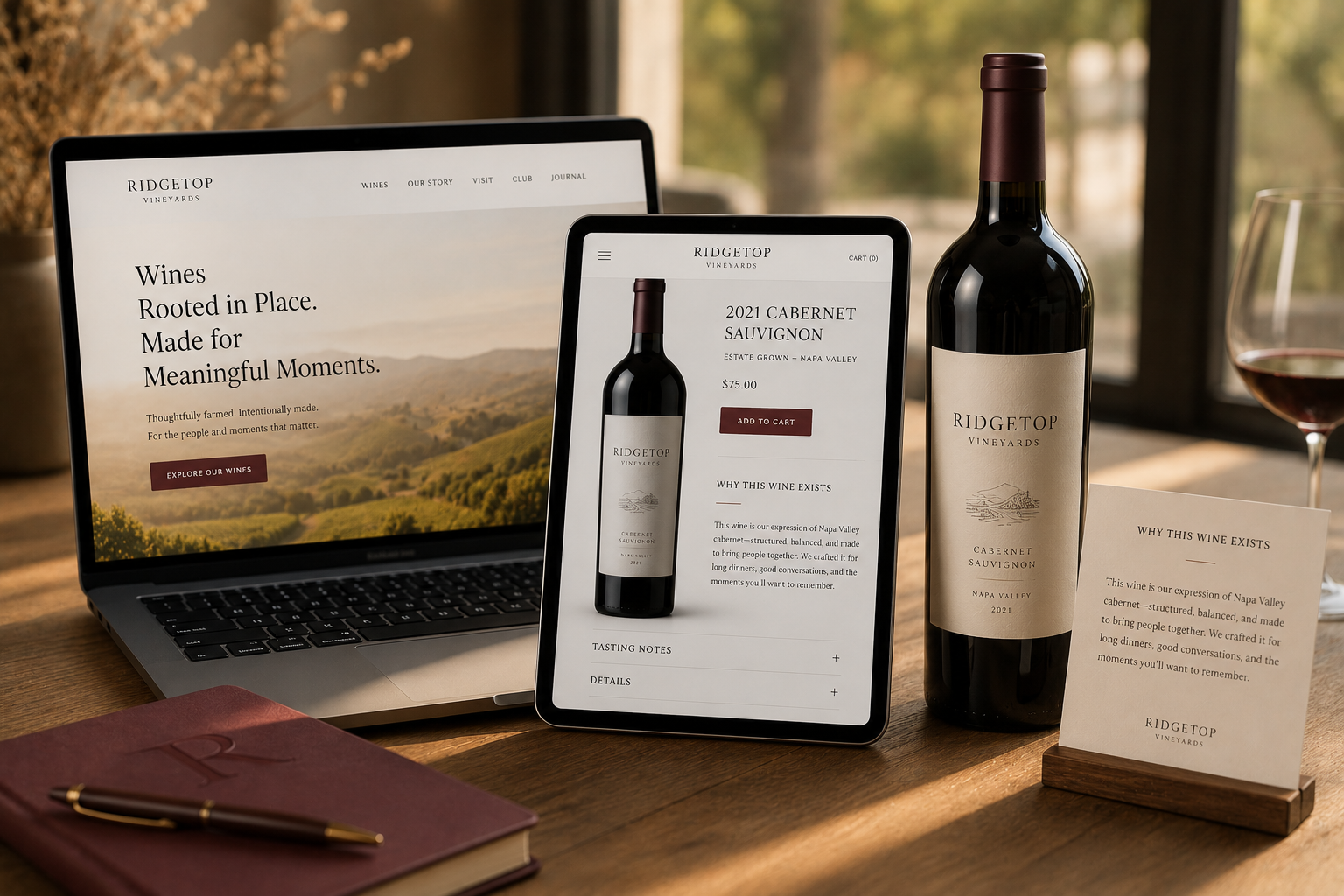
This is where the sale happens, yet many product pages rely almost entirely on tasting notes and technical details.
Add a short section that explains why the wine exists and where it fits into a customer’s life. Help them picture the moment, not just the flavor.
When a customer can imagine opening the bottle, the purchase feels more natural.
This is one of the most valuable pages on your site, and it is often reduced to a list of benefits and discounts.
Your club is not just a transaction. It is an identity and an experience.
Use story to answer who the club is for, what kind of member belongs here, and what it feels like to be part of it. When customers see themselves in that story, joining becomes an easy decision.
The sale is not the end of the story. It is the beginning of the relationship.
Most post-purchase emails focus on order confirmation and logistics. While that information is necessary, it is also an opportunity to reinforce your brand and deepen the connection.
Share why the wine was made, how to enjoy it, or what to expect next. This builds anticipation and increases the likelihood of repeat purchases.
Your tasting room is where your story becomes real. If the language used here does not match what customers saw online, it creates a disconnect.
Equip your team with a consistent way to describe each wine and the brand as a whole. Focus on moments and experiences rather than only technical details.
When the story feels aligned across digital and in-person experiences, it builds trust and encourages purchase.
Many wineries are already investing time and effort into storytelling, but the impact is limited by how it is used.
When the focus is only on savings, the value of belonging is lost. Customers may join for the offer, but they are less likely to stay.
If every email is a sale, the relationship becomes transactional. Over time, engagement drops and customers tune out.
Story adds meaning to both of these areas and creates a reason to stay connected.
Storytelling works best when it is structured in a way that supports action.
Use this sequence as a guide.
Hook: Capture attention with a clear and relevant idea. This could be a belief, a moment, or a point of difference.
Context: Provide just enough background to help the customer understand why it matters.
Emotional payoff: Show what the customer gains, whether that is a feeling, an experience, or a sense of identity.
Clear call to action: Make the next step obvious and easy. Do not assume the customer will figure it out on their own.
This structure keeps your story focused and ensures it leads somewhere meaningful.
Consider a simple customer journey.
A potential customer sees an ad that introduces a clear idea about your wines. They click through to a landing page that expands on that idea and shows how it fits into their life. They move to a product page that reinforces the same message while helping them picture the moment. After purchase, they are invited to join the club with language that reflects the same tone and values.
At every step, the story is consistent and connected to a decision.
You do not need a full redesign to improve results. Small changes in the right places can have a meaningful impact.
Add a short section to your product pages that explains why each wine exists and when it should be opened.
Rewrite your wine club headline to focus on who it is for and what it feels like to be part of it.
Train your tasting room team to use one consistent story for each wine so that every guest hears the same message.
These are simple shifts, but they directly influence how customers experience your brand.
Choose one touchpoint in your customer journey. It could be your homepage, a product page, or your wine club signup.
Apply the structure of hook, context, emotional payoff, and clear call to action.
Keep it simple, keep it specific, and focus on helping the customer understand why it matters.
When your story shows up at the right moment, it stops being background content and starts driving results.
1 min read
Blackberry. Cedar. Vanilla. Great. But no one buys a case because of “hints of graphite.”
1 min read
Every winery says they’re “family-owned,” “passionate,” and “committed to quality.” That is not a story. That is the baseline.
1 min read
If your website sounds premium, your emails sound promotional, and your tasting room sounds casual… You do not have a brand voice, you have multiple...